

Orphanage Highlight: The Day She Finally Felt Seen
(Name changed to protect privacy. We chose the name “Nadiya” because it means “Hope” in Ukrainian.)
When “Nadiya” arrived at the orphanage, she looked like a child carrying far more than a child should ever have to carry.
She is nine years old. Both of her parents are gone.
Before she came to the orphanage, she lived with relatives—but she wasn’t truly cared for. Not in the way a child needs. Not consistently. Not safely. Over time, neglect leaves marks that aren’t always visible at first: the kind that shows up in a child’s silence, in her hesitation to meet your eyes, in the way she holds herself like she’s trying to take up as little space as possible.
When she first arrived, she was painfully underweight. She was so small that the clothes they had didn’t fit her. She was behind in reading and writing, and she didn’t have the social skills most children develop naturally through steady care and belonging. It wasn’t because she couldn’t learn. It was because she hadn’t been given the chance.
And then something changed—not overnight, not like a movie scene, but in the slow, steady way that real healing happens.
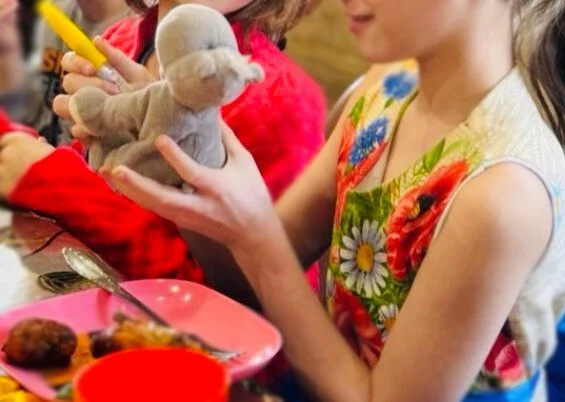
For some children, simple moments like a shared meal and a birthday celebration are brand new.
Meals became consistent. A routine appeared. Adults showed up again and again, not just once. She began to trust that she wouldn’t be forgotten. She started to gain weight—until she reached a healthy level for her age. She began learning letters, then words, then sentences. The orphanage put her into a special tutoring program at home to help her catch up to the grade level she should be in. It will take time. But she is moving forward.
And for the first time in her life, she had a birthday celebration. A simple cake. A candle. People gathered around her just for her. For most of us, it’s hard to imagine a childhood without birthdays. For Nadiya, that moment was new—and it mattered.
That is what stability does.
It doesn’t erase what happened. But it gives a child a chance to rebuild—one day at a time, one skill at a time, one small victory at a time.
When we talk about impact, this is what we mean. Not just donations, not just supplies, not just numbers—but a child who begins to stand a little taller, who starts to learn what she was never taught, who slowly becomes a kid again.
Nadiya’s story is one of many. And it’s also a reminder of why this work matters: because children don’t just need help surviving—they deserve the chance to grow, learn, and belong.